
AI-Powered Real-Time Drilling Monitoring System Project Overview
Explore how LADFAH applies engineering intelligence, AI, and connected data workflows to solve complex operational challenges across energy and industrial environments.
The Problem Disconnected Data and Reactive Workflows Were Driving Operational Risk.
Real-time drilling data existed across multiple sources, but teams lacked the speed and integrated context needed to identify developing conditions early. Mechanical dysfunction, delayed interpretation, and manual workflows were contributing to avoidable downtime and performance loss.
Severe Stick-Slip
Vibration
Extreme downhole vibration led to premature drill bit wear and catastrophic cutter degradation. This forced frequent, unplanned trips to change out the Bottom Hole Assembly (BHA).
High Non-Productive
Time (NPT)
Human operators could not analyze multi-variant surface and downhole data channels fast enough to react to lithological transitions. This resulted in low Rates of Penetration (ROP) and structural geosteering errors.
Manual Mud Logging
Bottlenecks
Delayed lag-time calculations and manual gas interpretation caused the geosteering team to miss optimal casing points, delaying target reservoir entry.
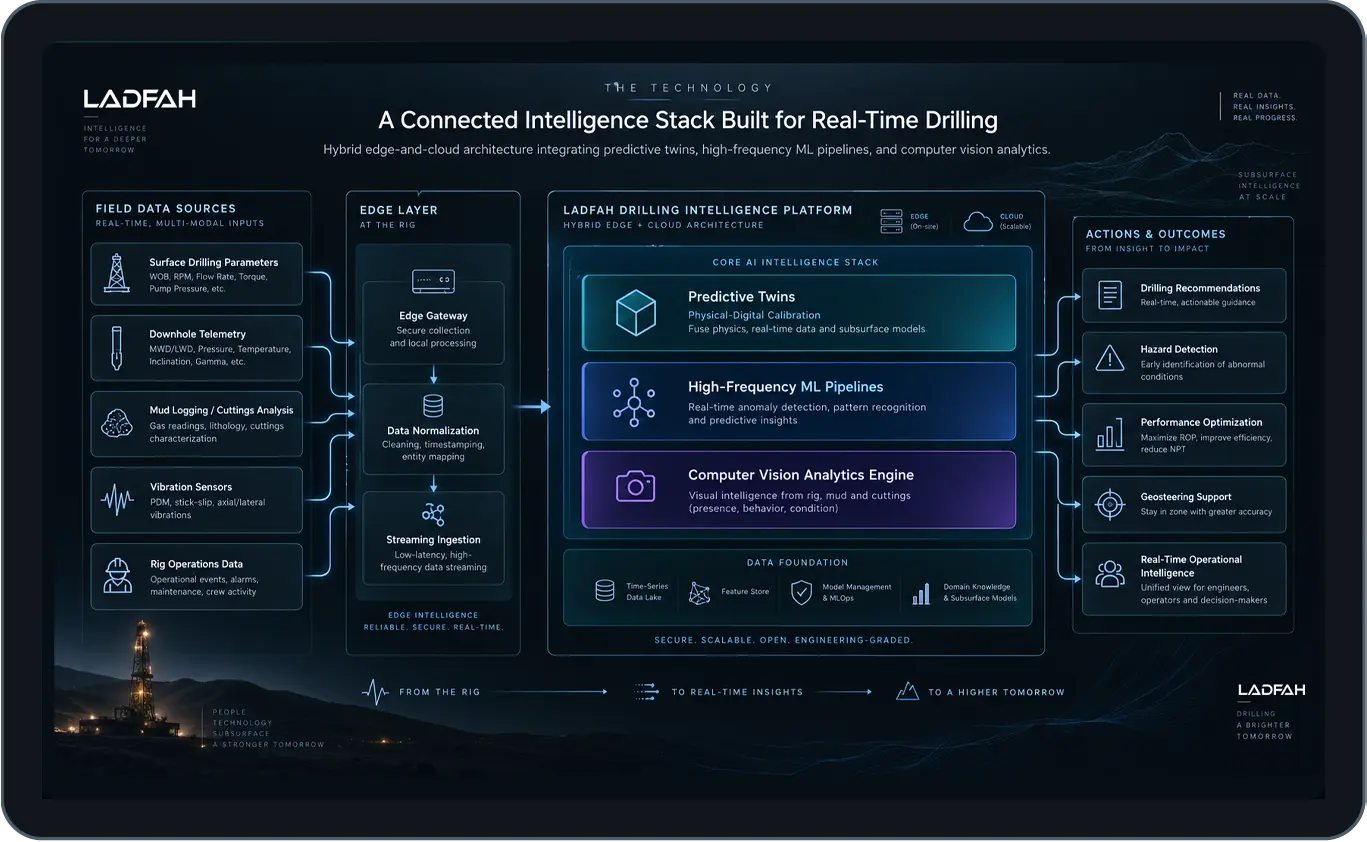
TECHNOLOGY ARCHITECTURE Three Intelligence Layers. One Real-Time Operating Environment.
A hybrid edge-and-cloud architecture connected physical drilling models, high-frequency operational data, and computer vision analytics to support faster detection, prediction, and optimization across the well construction workflow.
Predictive Twins
(Physical-Digital Calibration)
Live, high-fidelity digital replicas of the drill string, BHA, and wellbore geometry modeled downhole torque, mechanics, and fluid dynamics in real time.
High-Frequency
(ML) Pipelines
Deep neural networks processing automated surface parameter inputs (Weight-on-Bit, Surface RPM, Hook Load, Mud Pump Flow Rates) at 10Hz (10 samples per second).
Computer Vision
Analytics Engine
Edge-deployed vision algorithms monitoring rig floor vibration sensors and scanning mud-logging cutting samples at the shale shaker.
THE SOLUTION From Reactive Drilling to Continuous, Intelligent Optimization.
LADFAH connected predictive models, real-time drilling data, and automated interpretation into a closed-loop operating workflow—enabling the system to detect developing conditions, recommend corrective actions, and optimize drilling performance as operations evolved.
Autonomous Parameter
Optimization
The ML engine evaluated incoming lithology data against historical offset well datasets. It automatically recommended optimal Weight-on-Bit (WOB) and differential pressure setpoints to maximize ROP while staying safely under vibration thresholds.
Early Vibration
Mitigation
The Predictive Twin continuously checked torque metrics to flag micro-stick-slip anomalies. It automatically adjusted surface RPM to disrupt destructive downhole harmonics before physical damage occurred.
Automated
Mud Logging Integration
LADFAH’s Computer Vision module analyzed gas chromatography data and cutting structures simultaneously. It automatically calculated exact lag times, allowing Vanguard to verify production pay zones instantly without stopping operations.
THE OUTCOME
Faster Decisions.
Lower Operational Risk.
More Consistent Performance.
By connecting real-time drilling data with predictive models and automated interpretation, LADFAH helped shift the operation from reactive monitoring toward continuous decision support—giving engineering teams earlier visibility into developing conditions and a clearer path to corrective action.
Earlier Risk Detection
Developing drilling dysfunctions could be identified sooner, allowing teams to respond before minor anomalies became costly operational events.
More Consistent Performance
Continuous analysis of drilling parameters helped teams maintain more stable operating conditions and make better-informed optimization decisions.
Faster Formation Intelligence
Automated mud-logging and interpretation workflows reduced delays between field observations and engineering decisions.
LADFAH DRILLING INTELLIGENCE Bring Real-Time Drilling Intelligence
to Your Operations.
Connect live drilling data, predictive analytics, and engineering workflows in one intelligent operating environment built for faster, clearer operational decisions.
